How to Measure Kids’ Feet at Home (and When to Size Up)
Between fittings, kids’ feet do not wait for your calendar. They grow in bursts, often unevenly, and an online order placed on last term’s size is a gamble — Clarks Australia warns that kids’ feet can grow rapidly, and that getting the size right matters because shoes that are too big slip and blister while shoes that are too tight pinch and restrict natural foot growth. The good news: an accurate home measurement takes one sheet of paper, one pencil and about five minutes, and the centimetre figure you get is exactly what brand size charts and fitting tools ask for.
Last updated: 30 October 2026The short answer
Stand your child on a sheet of paper at full weight and trace around each foot. Measure the outline from the back of the heel to the tip of the longest toe, in centimetres, and use the longer of the two feet as your working figure — Australian first-walker brand Little SOHLS sets out exactly this method. Then leave growing room on top of that figure: around 14 mm for most school shoes, per Clarks’ buying guide, and approximately 0.7–1.5 cm for first walkers, per Little SOHLS.
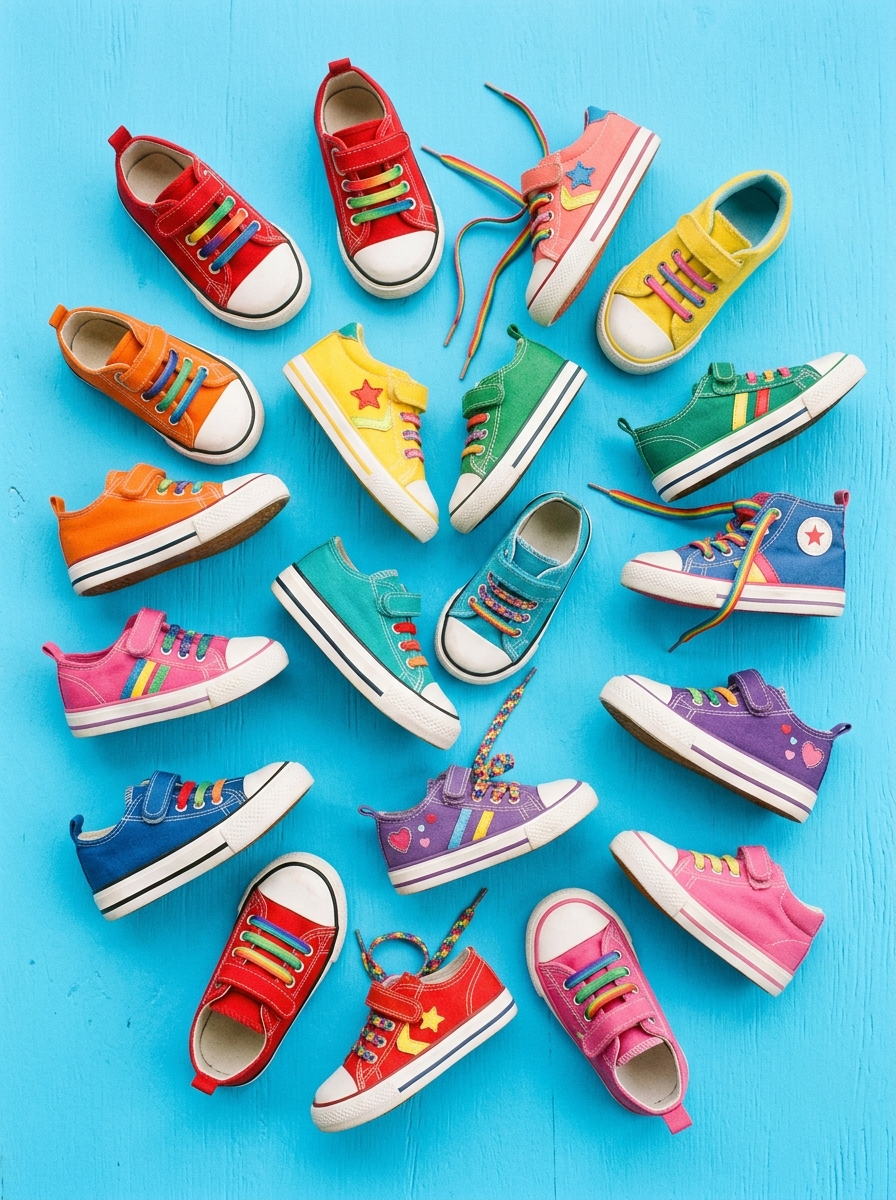
Five minutes, one sheet of paper: a home measurement you can trust between fittings.
Measure in six steps
Work through these in order. There are only two non-negotiables: your child must be standing, because a seated foot is not carrying weight, and you must do both feet — one foot’s number fitted to the other is how toes end up cramped.
Gather your kit
You need a sheet of paper or thin card bigger than the foot, a pencil, and a ruler or tape measure. Bare feet are best; if the shoes will be worn with socks, measure in the thin socks they’ll actually wear. Tape the paper to a hard floor so it can’t slide mid-trace — a wobbly outline is a wrong measurement.
Trace standing, at full weight
Have your child stand on the paper with their weight spread evenly across both feet — a heel resting lightly against a wall can help them stay put. Trace right around the foot, keeping the pencil upright and close to the skin the whole way. Little SOHLS’ guidance is explicit here: measure with the child standing at full weight, heel to longest toe.
Measure heel to longest toe
Draw a straight line from the back of the heel mark to the tip of the longest toe — which is not always the big toe — and write the result down in centimetres and millimetres. That single figure, not your child’s age and not last year’s size, is the number you take shopping and feed into brand size charts.
Do both feet, keep the longer
Repeat the trace on the other foot. Two feet are rarely identical, and both Clarks and Little SOHLS give the same instruction: measure both feet and use the longer measurement to choose the size. Shopping to the smaller foot’s number leaves the bigger foot with nowhere to go but into the end of the shoe.
Check the width too
Length is only half a fitting. Clarks advises measuring both length and width to get a snug yet comfortable fit, and its Australian product pages run a size calculator that takes both a size and a width measurement. If a foot traces wide, look for width fittings rather than jumping up a length size — Clarks offers whole sizes, half sizes and multiple width fittings across much of its kids’ range.
Pick your moment, write it down
Do the measuring when your child is up, settled and happy to stand still for a minute — a wriggling trace helps no one. Then record the date and the centimetre figure somewhere you’ll find it again. Clarks Australia suggests re-checking size before each new term, so make the trace a start-of-term habit while the school shoes are being bought anyway.
How much growing room?
Your measurement is the foot; the shoe needs to be a little more than the foot. Clarks’ current fit guidance for most of its school shoes is to allow around 14 mm from the longest toe to the end of the shoe — in the brand’s own words, “that space supports natural movement and growth, but it should not come with slipping.” It is the same figure our best school shoes in Australia guide works to when it talks about fit.
For first walkers, Australian brand Little SOHLS suggests approximately 0.7–1.5 cm of growing room, and adds the other half of the rule: too much extra space can make shoes harder to walk in. The principle is identical at every age — enough room for toes to move and feet to grow into, not so much that the foot slides around and the child has to grip or shuffle to keep the shoe on. Growing room is a measured margin, about a centimetre and a half at most, not a size or two of optimism.
The thumb test: your quick between-measures check that the growing room is still there.
When to size up: the thumb test and other signs
The quickest check between proper measurements is your thumb. With your child standing in the shoes, press gently across the front of the shoe, beyond the longest toe: you are feeling for roughly that 14 mm of growing room Clarks recommends. If your thumb comes down more or less straight onto toe, the growing room has been used up and it is time to move up a size — after confirming with a fresh trace, since a soft upper can flatter or hide what’s happening inside.
Other signs the current pair is done:
- The gap has closed. Your recorded centimetre figure has crept up to within a few millimetres of the shoe’s inside length — the growing room is gone.
- Toes are working overtime. Toes pressing or bunching at the front of the shoe means the length has run out; Clarks Australia notes that shoes which are too tight may pinch and restrict natural foot growth.
- A new term is starting. Clarks advises re-checking size before each new term regardless of how the shoes look, because growth rarely announces itself politely.
Some shoes even flag it for you — ASICS builds an ASICS SIZE CHECKER feature into its GEL-KAYANO 31 GS kids’ runner specifically to help kids identify when they’re outgrowing their shoes. And when you do size up, size up means the next size: Clarks is firm that you should never buy several sizes ahead to “get more wear” out of a pair. Every pick in our best kids shoes in Australia guide was chosen with that fit-first logic in mind.
Common mistakes that wreck the fit
- Measuring sitting down. A seated child’s foot is not loaded, so the trace undersells the foot that actually has to fit the shoe. Every source behind this guide measures standing — Little SOHLS says standing at full weight, full stop.
- Only measuring one foot. Feet differ, sometimes visibly. Both Clarks and Little SOHLS say to measure both feet and shop to the longer measurement; skipping the second foot is the most common home-measuring error.
- Buying big “to grow into”. Clarks says never to buy several sizes ahead for growing room, and Clarks Australia spells out the cost: shoes that are too big can cause slipping and blisters. You pay for oversizing twice — once in fit, once in falls.
- Sizing up to fix width. A wide foot in a longer shoe still rubs at the sides and now trips over the extra length at the front. Width fittings exist so wide and narrow feet can be fitted rather than sized up — the Clarks Daytona school shoe alone comes in 234 size options across multiple lengths and widths.
Get those four right and your home measurement is genuinely useful data — the same length-and-width information a fitter works from, which is why the fitting notes across our kids shoes guide keep coming back to it.
The method at a glance
| Step | Do this | Why |
|---|---|---|
| Trace | Child standing on paper at full weight; trace both feet | An unloaded foot gives you the wrong number (Little SOHLS) |
| Measure | Heel to longest toe, in centimetres; keep the longer foot’s figure | Brand size charts and calculators work from this figure |
| Width | Measure width as well as length | Clarks fits on both — width fittings beat sizing up |
| Growing room | About 14 mm for school shoes (Clarks); 0.7–1.5 cm for first walkers (Little SOHLS) | Room to grow and move, without slipping |
| Re-check | Measure again before each new term | Kids’ feet can grow rapidly (Clarks Australia) |
The bottom line
A home measurement is not a rough substitute for a fitting — done standing, on both feet, in centimetres, it is the same information the fitting tools use. Keep the figure current, leave about 14 mm of growing room (a little less for first walkers), and let the measurement, not the age on the box, decide the size you buy.
Kids’ shoe measuring questions, answered
How do you measure a child’s foot at home accurately?
Have your child stand on a sheet of paper at full weight and trace around the foot, keeping the pencil upright. Measure the outline from the back of the heel to the tip of the longest toe in centimetres — Australian first-walker brand Little SOHLS sets out exactly this standing method, and it is the figure brand size charts ask for. This standing trace is the reliable way to learn how to measure kids feet at home.
How much growing room should kids’ shoes have?
For most school shoes, Clarks’ buying guide puts it at around 14 mm from the longest toe to the end of the shoe — space that supports natural movement and growth without slipping. For first walkers, Little SOHLS suggests approximately 0.7–1.5 cm, and warns that too much extra space can make shoes harder to walk in. Once you know how to measure kids feet, the growing-room check takes seconds.
Should I measure both of my child’s feet?
Yes — two feet are rarely identical. Both Clarks and Little SOHLS say to measure both feet and use the longer measurement when choosing the size. Shopping to the smaller foot’s number is how the bigger foot ends up cramped against the end of the shoe. Using the longer foot is a key step when you learn how to measure kids feet.
How often should I re-check my child’s shoe size?
Before each new school term is a good rhythm. Clarks Australia advises re-checking size before each new term because kids’ feet can grow rapidly, and keeping a dated centimetre figure in your phone makes the comparison instant. Keeping a dated record makes it easier to remember how to measure kids feet each term.
What happens if kids’ shoes are too big or too small?
Clarks Australia is blunt about both: shoes that are too big can cause slipping and blisters, while shoes that are too tight may pinch and restrict natural foot growth. That is why growing room is a measured margin — about 14 mm — and Clarks says never to buy several sizes ahead to “grow into”. That measured margin is why parents who know how to measure kids feet rarely guess at sizes.
My child has wide feet — should I just buy a bigger size?
No. A longer shoe still rubs a wide foot at the sides and adds trip length at the front. Clarks offers whole sizes, half sizes and multiple width fittings across much of its kids’ range, and its Australian product pages run a size calculator that takes both a size and a width measurement — wide feet can be fitted rather than sized up. A proper width fitting matters just as much once you know how to measure kids feet.
Related guides: Best Kids Shoes in Australia · Best School Shoes in Australia. Browse all categories on the homepage.
Affiliate disclosure: Best Aussie Wear is a participant in the Amazon Australia affiliate program. As an Amazon Associate, we earn from qualifying purchases — at no extra cost to you. Prices on Amazon change; the price you pay is the price shown on Amazon at checkout. Read our full Affiliate Disclosure.